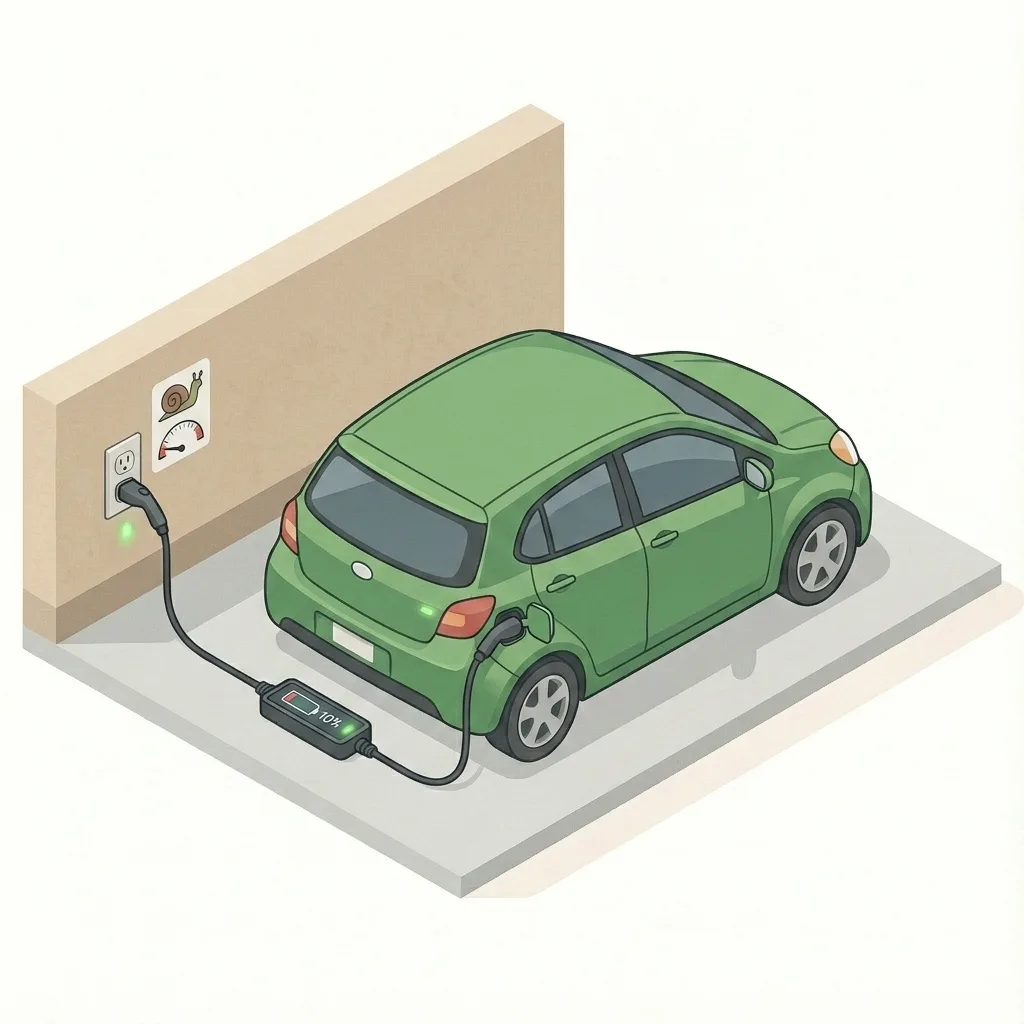
If you have rooftop solar and an EV, the obvious move seems like using your excess solar production to charge the car during the day. But there is a catch that most solar installers will not mention: when your panels are only producing 1.5-2 kW of surplus power, your EV's charging system wastes a surprisingly large fraction of that energy before it reaches the battery.
Measured data from laboratory tests and real-world owner tracking shows that charging an EV at 2 kW typically results in only 65-84% of wall power reaching the battery. At 1.4 kW, the minimum that most EVs can accept, efficiency can drop as low as 65% for some models. Compare that to 93% efficiency at 7 kW from a dedicated wallbox, and the gap becomes significant over a year of charging.
How much energy is actually lost
The numbers vary by vehicle, but the pattern is consistent across every EV tested. Independent testing by ADAC (Germany's automobile club) measured charging losses across four vehicles at household outlet power (approximately 2.3 kW) versus an 11 kW wallbox:
| Vehicle | Loss at 2.3 kW | Loss at 11 kW |
|---|---|---|
| Renault Zoe | 24.2% | 9.7% |
| Volkswagen ID.3 | 13.6% | 9.0% |
| Tesla Model 3 | 15.2% | 7.7% |
| Fiat 500e | 12.7% | 6.3% |
A peer-reviewed 2014 study published in the Transportation Research Record found Level 1 charging (120V, 1.2-1.9 kW) averaged 83.8% efficiency versus 89.4% for Level 2 (240V, higher power). More recent research from the Technical University of Denmark testing 38 EV models confirmed that onboard charger efficiency averages around 90% at maximum power but drops to approximately 83% at minimum power.
For solar-specific scenarios, research compiled by S44 Energy found that at 1.4 kW, typical of the minimum solar surplus a charger can use, efficiency drops to 65% for a Peugeot e-208 and 77% for a Tesla Model Y. At 2.3 kW it improves to 84%, and at 6.9 kW from a three-phase wallbox it reaches 93%.
The Hyundai Ioniq 5 illustrates the pattern well. Its onboard charger is rated at 92% efficiency at full Level 2 power (approximately 10.9 kW). But owner measurements show efficiency dropping to around 88% at 40A, 85% at 16A, and below 75% when using a slow plug charger at minimum current. The car's fixed overhead, cooling pumps, battery management, control electronics, draws roughly 200-480W regardless of how much power is flowing to the battery.
Why low power charging wastes energy
Two mechanisms combine to make low-power charging inefficient:
Fixed overhead power. Every EV draws 100-400W of power while charging, regardless of charge rate. This powers the battery management system, cooling pumps, 12V system, security electronics, and cellular connectivity. At 7 kW, a 300W overhead represents only 4% of total power. At 2 kW, that same 300W is 15% of total power; wasted before any energy reaches the traction battery.
AC-to-DC converter efficiency curve. The onboard charger that converts AC wall power to DC battery power operates most efficiently near its rated capacity. Power electronics have switching losses, diode voltage drops, and magnetic core losses that are relatively constant regardless of load. At 25-40% of rated power, efficiency drops below 85% according to instrumented measurements from KU Leuven published in IEEE proceedings.
These two effects compound. A vehicle with 300W of fixed overhead and an onboard charger rated at 11 kW will see the charger operating at only 18% of capacity when fed 2 kW. The charger's own efficiency at that load point might be 80-85%, and the fixed overhead consumes another 15% of input power. Together, 25-35% of the solar energy never reaches the battery.
The solar conversion chain
For a typical rooftop solar installation feeding an EV through a standard Level 2 charger, every watt passes through multiple conversion stages:
- Solar panels to inverter (DC to AC): 96-98% efficiency at moderate loads; drops to 89-91% at very low loads (5% of rated capacity)
- EVSE passthrough (AC to AC): 99%+; the wall connector itself wastes very little
- Onboard charger (AC to DC): 65-93% depending on power level; this is where most losses occur at low power
- Battery acceptance: Additional 1-3% loss from internal resistance
At 2 kW of solar surplus, the cumulative efficiency of this chain is typically 75-84%. At 7 kW, it improves to 88-93%. The Department of Energy estimates overall charging losses of 10-16% under normal Level 2 conditions, but that figure assumes charging near rated power, not the low-power trickle that solar surplus charging often produces.
What this means for solar EV owners
For a homeowner generating 2 kW of midday solar surplus and diverting it to their EV, roughly 0.3-0.7 kW of every kilowatt is lost to conversion overhead. Over a year of daily charging, that adds up. S44 Energy estimated the annual cost of charging at 2.3 kW versus 6.9 kW at approximately 345 kWh of additional consumption, roughly $50-100 depending on your electricity rate.
This does not mean solar EV charging is a bad idea. It means the approach matters:
Charge at higher power when possible. If your solar system produces enough surplus to sustain 5-7 kW, efficiency improves dramatically. A 6-10 kW solar array on a sunny day can often sustain efficient charging rates.
Consider a home battery buffer. Storing solar energy in a home battery (at 94-96% round-trip efficiency for DC-coupled systems) and then charging the EV at full Level 2 speed in the evening can be more efficient than trickle-charging at 1.5-2 kW all day. The math depends on your specific equipment and electricity rate structure.
Avoid charging below 1.4 kW. The J1772 and IEC 61851 standards set a minimum signaled current of 6A. Below this threshold, most EVs cannot charge at all. Smart solar diverters like the myenergi Zappi enforce this minimum; they will not start a charge session until surplus exceeds approximately 1.4 kW (at 240V). On days with marginal solar production, the charger may cycle on and off repeatedly, wasting energy on each restart.
Evaluate the export-vs-charge tradeoff. If your utility offers net metering or a feed-in tariff, exporting low-surplus solar and charging the EV at full speed during off-peak hours may deliver more usable energy to your battery than inefficient daytime trickle charging.
Watch for DC-coupled solar charging. Emerging products from manufacturers like SolarEdge and Sigenergy bypass the onboard charger entirely by delivering DC power directly from solar panels to the EV battery through a DC fast charging connection. These systems report efficiencies above 98% regardless of power level, eliminating the low-power penalty. However, they require compatible DC charging ports and are not yet widely available for residential installations.
The bottom line
Charging your EV from solar is still one of the cheapest ways to fuel a car. But the efficiency penalty at low power levels is real and measurable: 15-35% losses at 1.5-2 kW versus 7-10% losses at 7+ kW. Understanding this tradeoff helps you design a system and charging schedule that captures more of your solar production as usable miles.