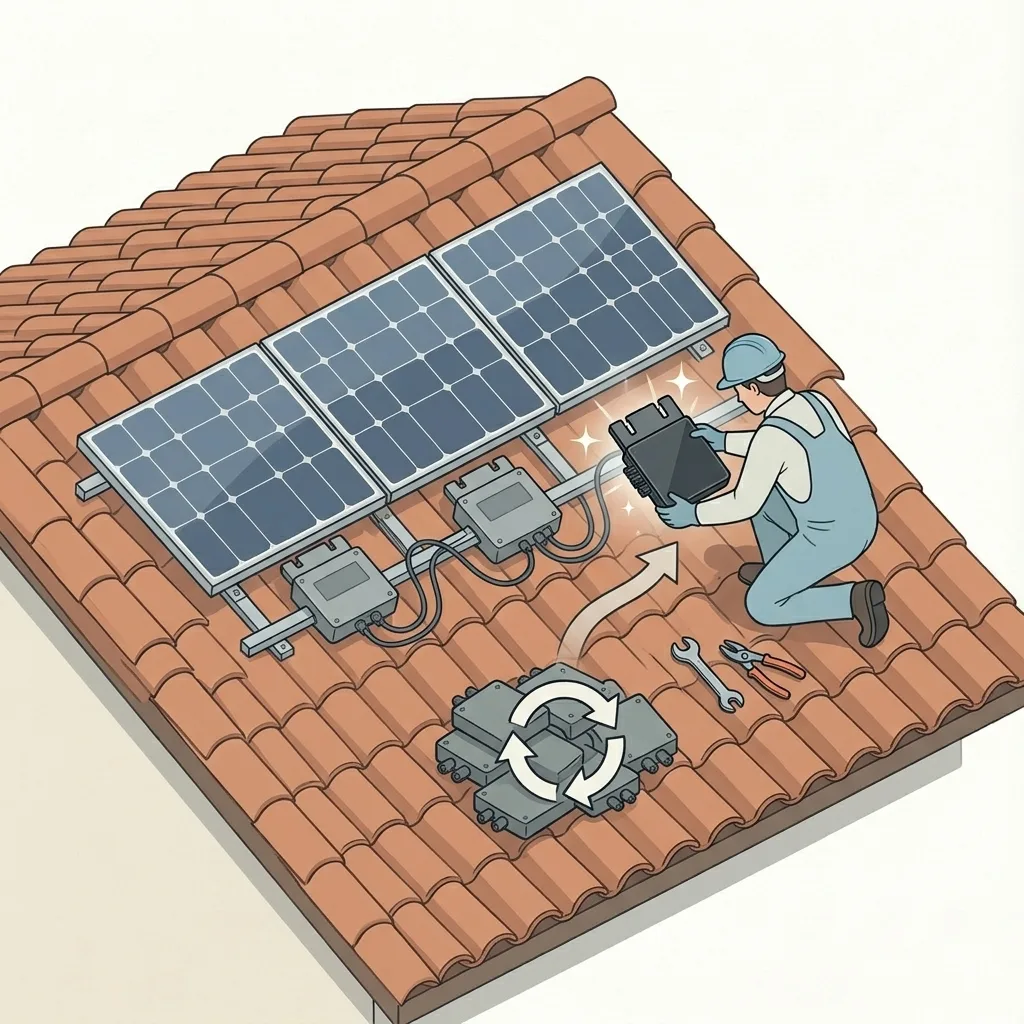
When a homeowner recently described upgrading their decades‑old solar array, one detail stood out: Enphase offered a particularly favorable deal on the legacy upgrade program for three batteries. While that language suggests a special promotion, the Enphase Upgrade Program is a standing initiative that many homeowners with older Enphase systems may be eligible for.
Enphase offers a legacy upgrade program for owners of its older microinverter systems that now includes battery storage as a core component. The program has been running since at least 2019, when Enphase announced it had surpassed 5,300 enrolled homeowners. It has since expanded from microinverter‑only replacements to a full ecosystem upgrade covering IQ8 microinverters, IQ Batteries, and IQ EV Chargers.
Here is what the program includes, who qualifies, and what to consider before signing up.
Who qualifies for the upgrade program
Enphase structures its upgrade program in four tiers based on the age and model of existing microinverters:
| Tier | Eligible Models | Available Upgrades |
|---|---|---|
| Earliest adopters | M175, M190, M210, D380 | IQ8 or IQ7PD microinverters, batteries, EV charger |
| Early adopters | M215, M250 | IQ8 microinverters (including IQ8X for high‑wattage panels), batteries, EV charger |
| S‑Series owners | S230, S280 | IQ8 microinverters, batteries, EV charger |
| IQ6/IQ7 owners | IQ6, IQ7 series | Latest IQ8, batteries, EV charger |
Owners of the oldest models, M175, M190, M210, and D380, have access to an "early adopter" tier with the deepest discounts. One authorized installer documented a 50 percent equipment discount for this group, with pricing of $67.50 per panel for microinverter replacements. Whether M215 and M250 owners receive the same discount level is less clear; the broader upgrade program does not publish specific pricing, instead routing homeowners through individual consultations with Enphase energy advisors.
Participation is voluntary. Enphase continues to honor existing warranties regardless of whether an owner joins the upgrade program.
What the battery upgrade path looks like
Batteries were not part of the original upgrade program when it launched. The program initially focused on replacing aging microinverters with IQ7 units. Battery storage became a formal option in January 2021, when Enphase announced that its storage systems were now compatible with M215 and M250 microinverter‑based solar installations, opening the upgrade path to approximately 300,000 additional homes.
This compatibility announcement was significant because it meant M‑series system owners could add IQ Batteries without replacing their microinverters or solar panels. Homeowners who want both new microinverters and batteries can bundle both through the program, but the battery addition does not require a full system repower.
The current battery lineup available through the program includes:
| Model | Capacity | Continuous Power | Efficiency | Warranty |
|---|---|---|---|---|
| IQ Battery 5P | 5.0 kWh | 3.84 kW | 90 % | 15 yr / 6,000 cycles |
| IQ Battery 10T | 10.08 kWh | 3.84 kW | 89 % | 10 yr (ext. to 15 yr) |
| IQ Battery 10C | 10.0 kWh | 7.08 kW | 89 % | 15 yr / 6,000 cycles |
The IQ Battery 5P is modular and can scale up to 80 kWh across multiple units. The newer 10C, launched in mid‑2025, offers 34 percent greater energy density and requires up to 62 percent less wall space than previous models. All use lithium‑iron‑phosphate (LFP) chemistry, which has a longer cycle life and lower fire risk than the nickel‑manganese‑cobalt (NMC) chemistry used in some competing products.
One technical constraint worth noting: M215 and M250 retrofit installations require a minimum of 10 kWh of IQ Battery capacity, plus additional equipment including the IQ System Controller 2 and IQ Combiner. IQ Battery 5P units cannot be mixed with older 3 or 10 series batteries in the same system.
What it actually costs
Enphase does not publish upgrade program pricing for batteries. Equipment and installation costs are determined through individual consultations, and pricing may vary by installer and region.
Published market rates for Enphase batteries outside the upgrade program provide a baseline:
| Configuration | Equipment Cost | Installed Cost |
|---|---|---|
| Single IQ Battery 5P (5 kWh) | $3,000–$5,000 | $5,500–$8,000 |
| Two IQ Battery 5P (10 kWh) | $6,000–$10,000 | $10,000–$12,000 |
| IQ Battery 10T (10 kWh) | $8,000–$10,000 | $15,000–$22,000 |
These figures represent standard retail pricing. The upgrade program may offer reduced equipment costs; the earlier homeowner's description of a “sweetheart deal” reflects how the program can provide attractive pricing, but the specific discount on battery hardware versus microinverter hardware is not publicly documented.
The payback period for an Enphase battery system averages 7 to 9 years when combining energy savings with utility demand‑response program payments, according to Boston Solar's 2026 analysis. That calculation assumed the 30 percent federal tax credit was still available, which changes the math for 2026 installations.
Tax credits and incentives have shifted
The federal Section 25D Residential Clean Energy Credit provided a 30 percent credit on battery storage costs with no dollar cap. Batteries had to have a minimum capacity of 3 kWh and could be added to an existing solar installation independently; new panels or microinverters were not required simultaneously to qualify.
That credit expired December 31, 2025 under the One Big Beautiful Bill Act. Systems installed and paid for before the cutoff can still be claimed on 2025 tax returns using IRS Form 5695. Unused credits carry forward indefinitely. Homeowners adding batteries in 2026 or later have no federal tax credit for homeowner‑owned systems.
State and utility programs remain the primary incentive path:
- California SGIP: Dollar‑per‑kWh rebate, with enhanced funding for low‑income households and fire‑threat districts. Income‑qualified tier offers up to $1,100 per kWh.
- Connecticut: Up to $16,000 for residential battery storage plus annual performance incentives.
- New York NYSERDA: Up to $6,250 per site for grid‑connected battery systems.
- Massachusetts/Rhode Island ConnectedSolutions: Annual demand‑response payments averaging $275 per kW in Massachusetts. Two IQ Battery 5P units could generate approximately $900 per year.
- Vermont Green Mountain Power: Battery lease program at $55 per month or a one‑time $5,500 for two IQ Battery 10C units.
- Hawaii HECO Battery Bonus: Up to $3,264 cash incentive plus bill credits.
For California homeowners on grandfathered NEM 1.0 or 2.0 rates, Enphase developed a configuration using IQ Microinverters, IQ Batteries, and Power Control software that allows system expansion without triggering a transition to less favorable NEM 3.0 rates. This has been approved by PG&E and SCE and is a significant motivator for California legacy system owners.
The garage heat problem is real
Solar batteries can generate meaningful heat during the charging process, and the homeowner who prompted this article reported that their three batteries significantly raise garage temperatures during continuous daytime charging. The Enphase IQ Battery 5P operates at full charging performance between 15 °C and 45 °C (59 °F to 113 °F). Above that range, charging derates progressively: 80 % capacity at 35 °C, 60 % at 40 °C, 40 % at 45 °C, and charging stops entirely above 50 °C. Garage temperatures in hot climates routinely exceed these thresholds; measurements from Florida, Arizona, and Southern California document garage peaks of 115 °F to 130 °F (46 °C to 54 °C).
One detailed case study measured a garage installation before and after cooling interventions. Without cooling, the garage peaked at 115 °F with battery temperatures reaching 105 °F and round‑trip efficiency of 88 %. After adding a radiant barrier and thermostat‑controlled exhaust fan—roughly $200 to $500 in materials—the garage temperature dropped to 92 °F, battery temperature fell to 85 °F, and efficiency improved to 94 %.
For homeowners in hot climates, the installation location deserves as much consideration as the battery selection. Building codes restrict residential battery placement to garages, utility closets, and outdoor locations, not habitable spaces. Where garage temperatures are extreme, outdoor wall‑mounted installations or insulated enclosures with active ventilation may preserve more usable capacity.
Efficiency in practice versus on paper
The Enphase IQ Battery 5P is rated at 90 % round‑trip efficiency. In practice, some owners report lower effective efficiency once standby consumption is factored in.
Enphase documentation states the battery consumes approximately 150 to 400 watt‑hours per day in standby, depending on the battery profile and system configuration. For a single 5 kWh battery cycled daily, that standby draw reduces effective round‑trip efficiency from 90 % to roughly 84 to 87 %. Multiple forum users have reported even lower figures, in the range of 65 to 74 %, though some of these reports may reflect sensor misconfiguration or firmware issues rather than actual energy losses.
This gap between rated and real‑world efficiency is not unique to Enphase; it affects all residential battery systems to varying degrees. But it is worth accounting for when calculating payback periods, particularly for smaller battery configurations where standby consumption represents a larger percentage of total throughput.
How it compares to other upgrade paths
The Enphase Upgrade Program is not the only option for homeowners with aging solar systems.
Tesla Powerwall 3: Higher capacity per unit (13.5 kWh) and higher continuous output (11.5 kW) at comparable or lower cost per kWh ($852–$1,000 per kWh). However, its DC‑coupled architecture makes it less straightforward to retrofit onto existing microinverter‑based systems. Better suited for new installations or string‑inverter systems.
FranklinWH aPower 2: 15 kWh per unit, expandable to 225 kWh. Competitive pricing ($778–$926 per kWh). Works well for retrofitting non‑Enphase systems but lacks the integrated ecosystem advantages of staying within the Enphase platform.
Independent repower: For systems beyond 15 years, a complete repower with new panels, inverters, and batteries from any manufacturer may be more cost‑effective than an incremental upgrade. Repowering costs run 10 to 30 percent more than new installations but preserves existing interconnection rights and electrical infrastructure.
The Enphase program's strongest advantage is for homeowners already in the Enphase ecosystem. The IQ8 microinverter's grid‑forming capability means the battery can power the home during outages without a separate transfer switch. The Enphase App provides unified monitoring across microinverters, batteries, and EV chargers. And the AC‑coupled architecture means battery installation does not require rewiring the existing solar array.
What to check before signing up
Verify your eligibility tier. The deepest discounts documented, 50 percent off equipment, apply to the earliest adopter models (M175, M190, M210, D380). M215 and M250 owners participate in the broader program with individually quoted pricing.
Get multiple quotes. The program routes you through an Enphase energy advisor, but installation is performed by local contractors. Labor costs vary significantly by region; Northeast and West Coast urban markets run 10 to 30 percent above Midwest averages.
Stack incentives. The upgrade program discount can be combined with state rebates, utility demand‑response programs, and any remaining federal credits for pre‑2026 installations. Run the numbers for your specific location and utility.
Plan for heat management. If your installation location is a garage in a hot climate, budget for ventilation or cooling measures. A $200 to $500 investment in a radiant barrier and exhaust fan can recover roughly six percentage points of round‑trip efficiency.
Understand the minimum requirements. M215 and M250 battery retrofits require at least 10 kWh of storage capacity plus a system controller and combiner. This sets a floor on the investment that may exceed what some homeowners need for basic backup.
The Enphase Upgrade Program is one of the few manufacturer‑led initiatives that provides a structured, warranty‑backed path for modernizing legacy residential solar installations. Whether the pricing qualifies as a “sweetheart deal” depends on the specific quote offered during consultation, but the program itself is real, well‑established, and available to a large installed base of homeowners.